
Court of Justice of the European Union: ‘All Afghan girls and women seeking asylum are thus entitled to refugee status, solely on the basis of their nationality and gender’
Keren Rajohanesa, legal expert specialised in the rights of victims of gender-based violence, Passerell - Published on December, 20th 2024Version Française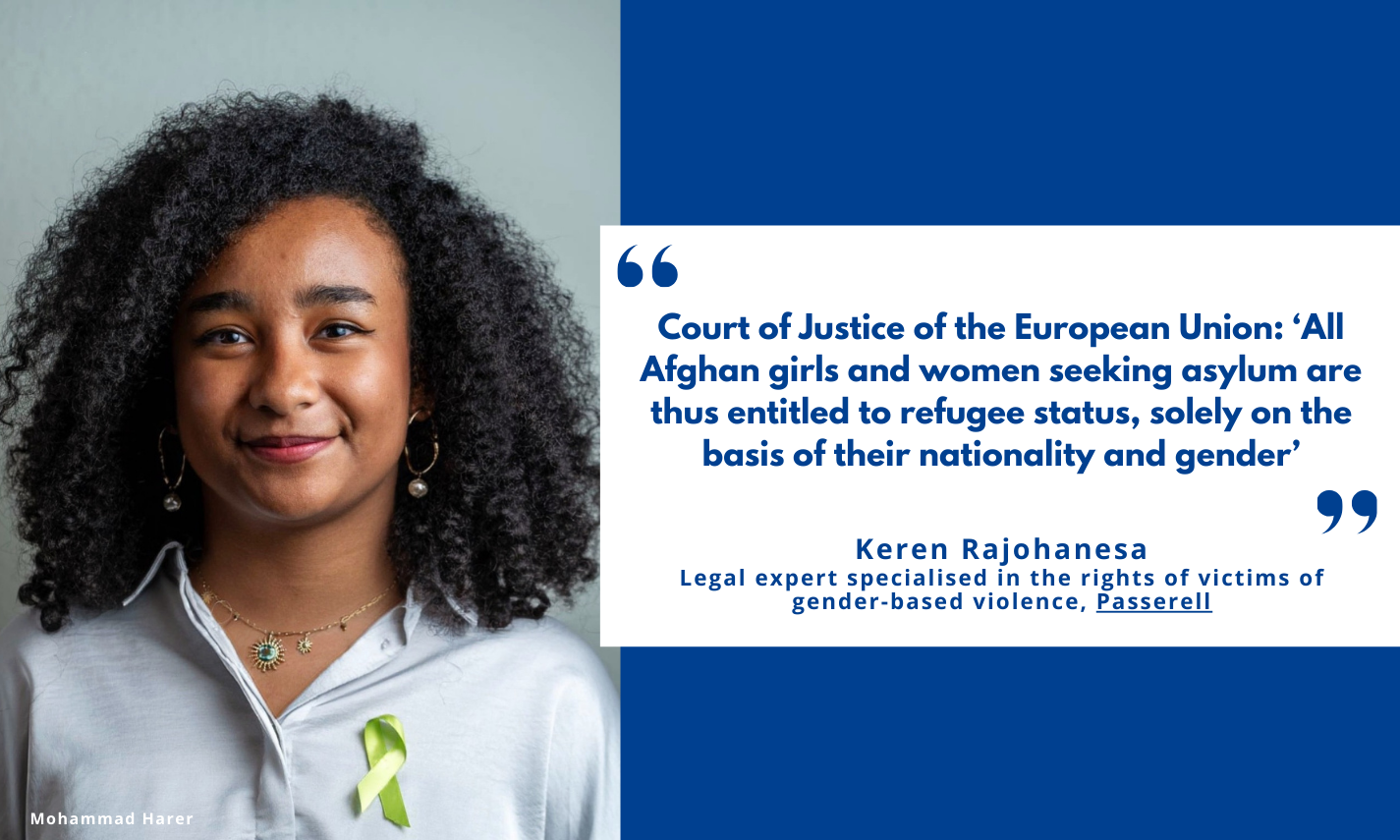
On October 4th, 2024, the Court of Justice of the European Union (CJEU) handed down a decision that marked a clear step forward for Afghan women’s right to asylum, giving gender an important place in international protection. Keren Rajohanesa, a legal expert specialised in the rights of victims of gender-based violence at Passerell, analyses this decision.
What was the Court’s case law prior to the decision of 4th October 2024 regarding the international protection of Afghan women?
Since the entry into force of the Istanbul Convention for the European Union on October 1st, 2023, the Court has begun the process of formally recognising gender-based violence as a form of persecution.
On January 16th 2024, it handed down a judgment (‘Women victims of domestic violence’) in which it ruled that the common European asylum system must be interpreted in compliance with the Istanbul Convention, even though some Member States had not ratified it. According to the Court, women can be categorised as belonging to a particular social group when, in their country of origin, they are exposed to physical or mental violence, including sexual violence and domestic violence, because of their gender.
On June 11th,2024, the Court handed down another judgment (‘KL’) concerning two young Iraqi women who subsequently applied for international protection because of their ‘westernisation’ in the Netherlands. The Court held that women and girls who ‘share as a common characteristic the fact that they genuinely come to identify with the fundamental value of equality between women and men’ can be considered as belonging to a certain social group.
The ruling of October 4th, 2024 is part of a set of case law which is more protective for women who seek international protection.
Is this an improvement for Afghan women compared to the Court’s decision of last January?
This ruling is an added value for Afghan women because the Court reiterates that certain forms of gender-based violence such as forced marriage are acts of persecution, and affirms that discriminatory measures, which on their own cannot be considered as acts of persecution, can, when taken together, constitute acts of persecution justifying the recognition of refugee status.
The Court is clear: in Afghanistan it denounces ‘the establishment of a social organisation based on a system of segregation and oppression’ of women. Based on reports from the European Union Asylum Agency (EUAA) and the Office of the United Nations High Commissioner for Refugee (UNHCR), it recognises that there is a presumption of recognition of the refugee status for Afghan women due to widespread gender-based persecution. All Afghan girls and women seeking asylum are therefore eligible for refugee status, solely on the basis of their nationality and gender.
Fear of persecution is a key element of the asylum application. How has the Court used the concept of systematic discrimination to protect these women?
The Court points out that acts of persecution as defined by the Qualification Directive are established in two cases: when they reach a degree of severity such that they violate fundamental rights considered to be ‘absolute’ (such as the right to life) and when they are an accumulation of measures, including violations of human rights, considered to be sufficiently serious to affect an individual in a manner ‘comparable’ to the first case.
The Court noted that while certain discriminatory measures could not in themselves constitute acts of persecution (limiting access to education and employment), the discriminatory measures systematically targeting Afghan women and girls, taken as a whole, deprived them of their dignity and reached such a degree of severity as to justify classifying them as acts of persecution.
This interpretation breaks away from the traditional approach taken by national asylum authorities. Examining applications for international protection without taking sufficient account of the generalised context of oppression of women is unsuitable for applications based on gender.
How does the Court’s approach to individual assessment in this decision endorse a gender-based view of refugee protection?
The Court recalls the principle established by the Qualification Directive that all applications for international protection must be subject to an individual assessment. Such an assessment involves a case-by-case analysis, based on relevant facts relating to the applicant’s country of origin and personal circumstances.
However, the Court allows this individual assessment to be supplemented by consideration of the particular collective situation of oppressed women in Afghanistan. This makes it possible to remove certain obstacles women may encounter in recounting their asylum claims or in providing evidence, by taking into account the widespread knowledge of persecution suffered by all women in Afghanistan. On the field, we note that, today, in some EU member states, some applications are rejected even though the nationality and gender of the applicant are not in question and there is no doubt that, if they return to their country of origin, they will be at risk of persecution because of their gender.
Can we envisage positive repercussions, particularly on national courts and on the development of international refugee law?
In the light of this case law, it is possible to consider decisions by asylum authorities being overturned, or even reversed, if they do not take into account the system of oppression against women and girls put in place by the Taliban. However, such progress in the jurisprudence and application of the Istanbul Convention depends on legal professionals being fully aware of these instruments. This is particularly urgent for Member States that have either not ratified the Istanbul Convention, are considering withdrawing from it and/or are reluctant to comply with it.
Regarding the development of international refugee law, this case law enshrines gender as a primary consideration in the examination of applications for international protection. The terminology used by the Court could enable to enables to rethink discriminatory measures targeting women and girls in other States, which may include various forms of gender-based violence.
On another topic :
Three years on, the state of play for Ukrainians in Europe
Finnish pushback law: ‘A major deviation for a once internationally renowned country of rule of law’ – Interview of Pargol Miraftabi, lawyer at the Finnish Refugee Advice Centre