At the border between Belarus and the European Union: pushbacks, militarisation, and repression policy
Advocacy team of France terre d'asile - Published on March 5th, 2025Version Française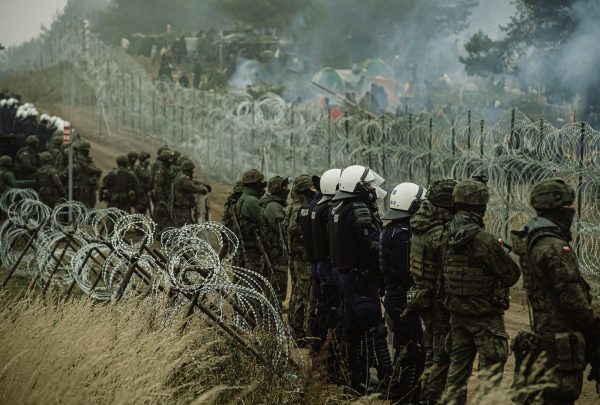
© Copyright Irek Dorozanski / DWO, Kancelaria Premiera, 2021
Many exiled people are hiding at the border between Belarus, Poland, and Lithuania. Pushed back at the European Union’s borders, many disappear or lose their lives, and numerous testimonies report violence and human rights violations.
Since 2021, the European Union (EU) has accused Alexander Lukashenko’s regime of instrumentalising exiled people at the Polish and Lithuanian borders as a tool for destabilisation. The fear and rejection of a “migration crisis” by European countries have led to the militarisation of the area and violent repression.
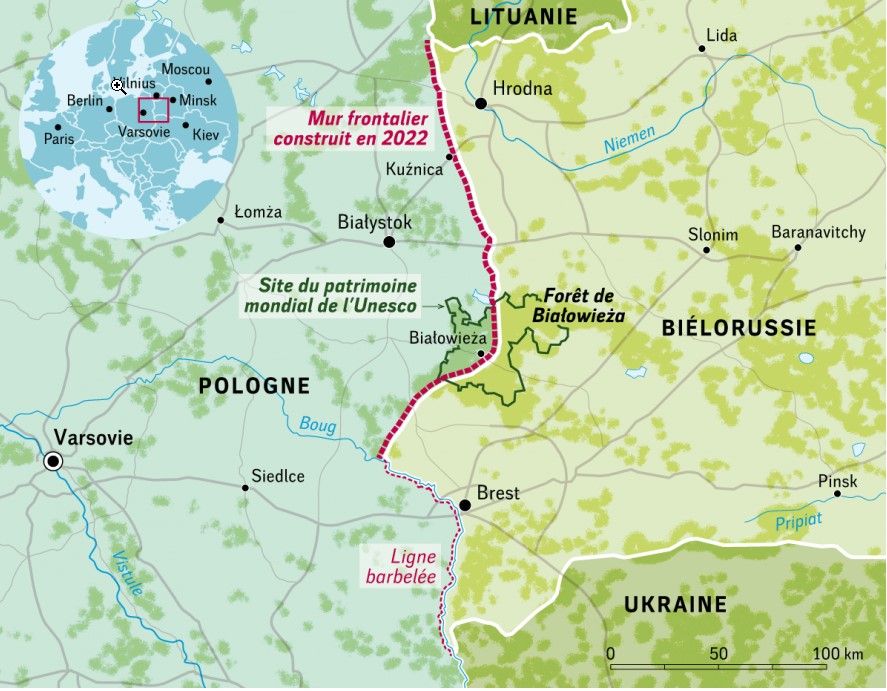
At the Polish border, exiled people are pushed back by Polish border guards or sent back to Poland by Belarusian authorities. Many go missing and bodies are regularly found by associations in the dense, freezing Białowieża forest. NGOs are sometimes directly contacted by families who have lost contact with their loved ones. They also work on identifying the deceased, helping families grieve, though repatriation rarely occurs.
The International Organisation for Migration (IOM) had already warned in 2021 about the inhumane living conditions of exiled people at the border, particularly their “limited access to drinking water and food, medical assistance, sanitation facilities, and shelter“. Currently, the situation is far from improving. Exiled people hiding in the forest are surviving despite sub-zero temperatures, the fear of wild animals, and a severe lack of water and food. Attempts to cross the border expose them to multiple forms of injury and violence, caused by fences and border guards. Trapped between the two countries, migrant people are beaten, stripped of their belongings and abandoned in the wilderness. Humanitarian organisations have treated people suffering from fractures and dog bites.
Pushbacks to the “death zone“
Lithuanian and Polish border guards regularly push back people to Belarus, a practice that is prohibited under international law. Official figures on pushbacks and asylum requests are difficult to access, but a report by an NGO consortium estimates that Poland carried out 13,600 pushbacks and Lithuania 1,002 in 2024.
Since 2021, Poland has been building a wall along the Belarusian border: a 5.5-meter-high fence topped with barbed wire, reinforced by an electronic surveillance barrier. Legislation allows border guards to use force in cases of “national security threats“, granting them the authority to shoot at individuals attempting to cross the border. The Polish government has also established a buffer zone, reserved for law enforcement and off-limits to humanitarian workers. These exclusion zones extend up to two kilometres inside Polish territory, severely hindering the work of aid organisations. Polish authorities refuse to issue the necessary permits for providing humanitarian aid within the exclusion zones, forcing NGOs to operate without authorisation or abandon their mission.
At the border, Polish “civil militias” have also emerged to support the authorities and “defend their country and values”, promoting a fight “against this wave of illegal immigration“. Humanitarian organisations present in the area are alarmed by this phenomenon and the dangers it poses to exiled people as well as the safety of aid workers.
The European Court of Human Rights (ECHR) has been seized in three cases concerning pushbacks and violence at the Polish, Latvian, and Lithuanian borders, carried out by authorities between 2021 and 2023.
The instrumentalisation: an avatar of the reception crisis
Since 2021, the countries bordering Belarus have denounced a “hybrid war” by Vladimir Putin and Alexander Lukashenko, aiming to instrumentalise exiled people to exert pressure on the EU. Donald Tusk, the Polish prime minister, accuses the Russian and Belarusian regimes of seeking to “destabilise the European bloc” in retaliation for the EU’s non-recognition of Lukashenko’s 2020 election and the European sanctions imposed on Belarus following the repression of pro-democracy protests that same year.
The instrumentalisation of migrant people, which began in 2021, would start in their countries of origin. Travel agencies would advertise trips to Belarus – or even directly to the EU – and submit short-term or group visa applications for those responding to these offers. Once they arrived in Belarus, exiled people would be welcomed by the travel agencies, which were counting on their continued journey to the EU. However, authorities noticed that some people stayed in Belarus. As a result, the government changed its strategy by transporting exiled people directly to the Polish and Lithuanian borders, threatening their lives if they returned. This created traps for thousands of people at the border.
In 2015, the increase in the number of people in need of protection arriving in Europe and the failure of a relocation policy within the EU led Member States to multiply measures preventing arrivals. In a logic of closure, Member States built walls at their borders and externalise reception, asylum, and border control to third countries such as Turkey, Morocco, Libya, Tunisia, Mauritania, and Egypt. This externalisation of European responsibilities allowed some States to use exiled people as a means of “pressure” against the EU.
The agreement signed with Turkey in 2016 to limit the arrival of Syrian refugees was used by President Recep Tayyip Erdoğan. When the agreement was renewed in 2020, Turkey opened its borders with Greece, encouraging migrant people to reach Europe in order to put pressure on the EU and secure increased financial compensation. In May 2021, amid diplomatic tensions with Spain, Morocco also suspended its border controls at the Ceuta enclave, allowing nearly 10,000 people to enter EU territory within two days.
In disregard of their international and European legal obligations, Member States responded by closing their borders. Greece suspended the registration of asylum applications for a month, and Spain carried out “hot returns” of nearly 8,000 people, including minors. EU resolutions urging third countries to uphold migration agreements regarding human rights did not prevent the renewal of these agreements or the continued externalisation of border control. By cooperating with countries with lower human rights standards, the EU bypasses its responsibilities, violates the rights of migrant people and fosters the risk of instrumentalising exiled people.
The EU responds, not without danger for exiled people.
The European Migration and Asylum Pact, adopted in May 2024 by the EU, introduced exceptions to the right to asylum in cases of “instrumentalisation” of migrant people by “foreign State actors“. The duration of asylum seekers’ registration at the border can be extended, and the number of people accepted may be reduced.
The instrumentalisation of exiled people and the response of Member States have thus entered the European legal framework. However, the definition of the term “instrumentalisation” remains extremely vague, leaving room for broad interpretation and manipulation of the concept. Some countries are also amending their national legislation, such as Finland with its “law on temporary measures to combat instrumentalised immigration“, also known as the “pushback law“.
Since January 2025, with the start of Poland’s presidency of the Council, the EU has granted countries facing “hybrid threats related to the militarisation of migration” the possibility of temporarily suspending the right to asylum. The Union is thus making concessions to illiberal democracies, even though Tusk has been highly critical of European law and particularly harsh regarding the Migration and Asylum Pact.
Hungary, Estonia, and Latvia have followed Poland’s example by building walls at their borders. In 2021, although twelve countries made an official request to the Commission, Ursula Von der Leyen had stated that the EU would not fund physical barriers at its borders. However, during a plenary session of the European Parliament in January 2025, Magnus Brunner, the European Commissioner for Home Affairs, suggested that the EU might finance physical barriers at its external borders, stating that “due to trends observed in recent years, it [was] clear that the global needs in border management [had] to be reassessed“. The EU is currently financing mobile and stationary units, surveillance systems, and recently allocated an additional 170 million euros to countries bordering Russia and Belarus.
On the same topic: the film Green Border directed by Agnieszka Holland
On another topic:
Pushbacks: Greece condemned by the European Court of Human Rights – European Insights
Three years on, the state of play for Ukrainians in Europe – European Insights
Court of Justice of the European Union: ‘All Afghan girls and women seeking asylum are thus entitled to refugee status, solely on the basis of their nationality and gender’ – Interview of Keren Rajohanesa, legal expert specialised in the rights of victims of gender-based violence – European Insights